
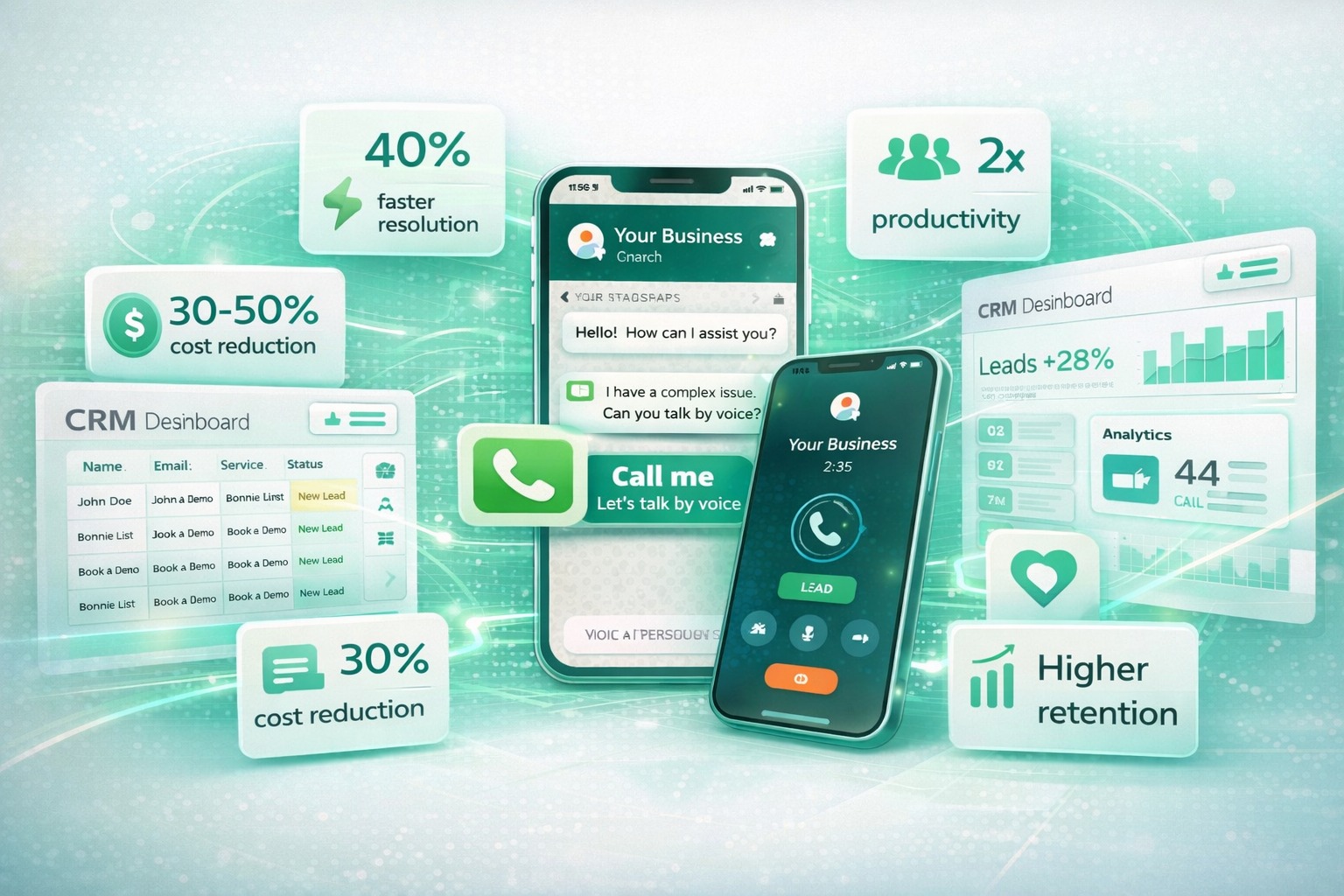
Eliminate customer drop-offs, reduce support costs, and improve resolution times with WhatsApp chat and calling. Discover how seamless conversations transform customer experience at scale.
Key Takeaways:
- Customers stay engaged when conversations move naturally from chat to voice without switching platforms
- Support teams resolve issues up to 40% faster with complete conversation context available during calls
- Businesses reduce telephony costs by 30–50% through predictable conversation-based pricing
- Customer retention improves significantly when interactions feel continuous and personalised
- Agents handle 2–3x more conversations daily without repeating information or losing context
- Global teams collaborate seamlessly across devices and time zones within a single conversation thread
The Real Problem Isn’t Volume, It’s Fragmentation
If you look closely at your customer support challenges, the issue isn’t just rising volumes or increasing costs. It’s fragmentation.
A customer starts a conversation on chat. The issue becomes slightly complex. Your team asks them to switch to a phone call. Suddenly, everything breaks. The customer repeats their problem, your agent starts from scratch, and what should have been a smooth interaction turns into frustration.
Multiply this across hundreds or thousands of interactions every day, and you get:
- Dropped conversations
- Rising telephony costs
- Overworked agents
- Inconsistent customer experiences
This is exactly where WhatsApp’s chat and calling capabilities come in.
WhatsApp Chat + Calling: One Continuous Conversation
Launched as part of the Business API evolution, WhatsApp now allows you to combine messaging and voice into a single, continuous interaction.
Instead of switching channels, your customer simply taps a button like “Call me” within the chat. The conversation instantly moves to voice without losing context. Every message, detail, and prior interaction stays visible to both the agent and the customer.
This simple shift changes everything. You are no longer managing channels. You are managing conversations.
The Core Shift: From Disconnected Channels to Seamless Experiences
Traditionally, businesses have treated chat and voice as separate systems. Messaging handles quick queries, while voice handles complex ones.
But in reality, customer needs don’t follow that structure.
A conversation might start simple and become complex within seconds. When your system forces a channel switch, you introduce friction at the worst possible moment.
With WhatsApp chat and calling working together:
- Conversations evolve naturally
- Context is never lost
- Customers stay engaged
- Agents stay efficient
This is not just a feature upgrade. It is a fundamental shift in how customer communication works.
Challenge 1: Customers Drop Off When Conversations Get Complex
The Business Reality
Customers prefer messaging because it is quick and convenient. But when their issue requires deeper explanation, they hesitate to move to a phone call.
Why? Because they know what comes next. Repeating everything again.
This is where many businesses lose customers silently. High-intent users simply abandon the interaction when friction increases.
The Solution: Voice Within the Same Conversation
With WhatsApp calling integrated into chat, the transition feels natural.
The customer does not dial a number or switch apps. They simply continue the same conversation using voice. The agent already has the full context, so the call starts exactly where the chat left off.
What This Means for Your Business
You immediately see measurable improvements:
- Faster issue resolution because there is no restart
- Higher engagement as customers stay within one flow
- Reduced abandonment during critical moments
In fact, businesses report up to 40% faster resolution times and significantly higher conversion rates when voice is introduced at the right moment.
Challenge 2: Rising Telephony Costs with No Predictability
The Business Reality
Traditional telephony operates on per-minute billing. As your support volume grows, your costs grow unpredictably.
During peak periods, this becomes even worse:
- Longer call durations
- Increased wait times
- Emergency scaling costs
Finance teams struggle to forecast expenses, while customers suffer from delays.
The Solution: Conversation-Based Pricing
WhatsApp changes the pricing model entirely.
Instead of paying per minute, you pay per conversation window. This includes both messaging and voice, regardless of how long the interaction lasts.
A customer can:
- Start with chat
- Move to voice
- Return to chat
And it is still treated as one interaction.
What This Means for Your Business
This model creates immediate financial clarity:
- 30 to 50% reduction in support costs
- Predictable budgeting for leadership teams
- No penalty for longer or more meaningful conversations
Businesses also find that they can handle higher volumes without proportional cost increases, turning support into a scalable function rather than a financial burden.
Challenge 3: Agents Losing Time Repeating Information
The Business Reality
In traditional systems, every call starts with basic questions:
- What is your issue?
- What have you tried?
- Can you share your details again?
This repetition wastes valuable time and frustrates customers who expect personalised service.
The Solution: Full Conversation Context
With WhatsApp, every message is part of a continuous thread.
When a call begins, the agent already sees:
- Previous messages
- Customer history
- Issue details
- Context from earlier interactions
There is no need to ask the same questions again.
What This Means for Your Business
The impact on efficiency is immediate:
- First-contact resolution rates increase significantly
- Agents handle 2 to 3 times more conversations daily
- Average handling time reduces without compromising quality
Support teams move from reactive problem-solving to meaningful engagement.
Challenge 4: Scaling Support During Peak Periods
The Business Reality
Every business faces peak periods, whether during festive seasons, product launches, or promotional events.
During these times:
- Support queues grow
- Customers wait longer
- Service quality drops
Scaling traditionally requires hiring more agents or investing in infrastructure, both of which take time and cost money.
The Solution: Built-In Scalability
WhatsApp’s infrastructure is designed to handle billions of interactions globally.
With chat and calling working together:
- Routine queries are handled through messaging or automation
- Complex issues are escalated to voice instantly
- Teams collaborate through group calls when needed
All of this happens without additional infrastructure setup.
What This Means for Your Business
You gain the ability to scale without friction:
- Handle up to three times the volume without increasing team size
- Maintain service quality even during peak demand
- Turn high-pressure periods into opportunities for better engagement
For industries like hospitality and ecommerce, this can directly impact revenue through better customer experiences.
Challenge 5: Compliance and Customer Trust
The Business Reality
Regulatory requirements around customer communication are becoming stricter.
Businesses need:
- Clear consent for calls
- Proper documentation
- Transparent communication records
Managing this manually is complex and risky.
The Solution: Built-In Consent and Audit Trails
WhatsApp simplifies compliance by embedding consent directly into the conversation.
Customers explicitly choose to receive a call through actions like tapping “Call me”. This consent is automatically recorded and linked to the interaction.
What This Means for Your Business
You reduce risk while improving trust:
- Clear audit trails for every interaction
- Higher response rates due to customer-controlled communication
- Stronger brand credibility
Compliance becomes a natural part of the process rather than an operational burden.
Real-World Impact: Hospitality and Ecommerce
In hospitality, seamless communication allows hotels and resorts to handle bookings, service requests, and guest issues without forcing customers to switch channels. Guests feel understood, leading to higher satisfaction and repeat bookings.
In ecommerce, businesses use chat for discovery and voice for decision-making. Customers can ask questions, receive personalized recommendations, and complete purchases without friction. This directly improves conversion rates and average order value.
From Support Function to Growth Engine
When you bring chat and calling together, support stops being just a cost centre.
Instead, it becomes:
- A driver of customer retention
- A contributor to revenue through better conversions
- A differentiator in competitive markets
Your agents are no longer just resolving issues. They are building relationships.
Getting Started: Why Implementation Matters
While the technology is powerful, the real value comes from how you implement it.
You need to:
- Design conversation flows
- Train teams to switch seamlessly between chat and voice
- Set up routing and escalation logic
- Track performance metrics
Working with experienced partners like BotSpice can significantly accelerate this process and ensure you achieve results quickly.
Conclusion: The Future of Customer Communication Is Unified
Customers do not think in terms of channels. They think in terms of conversations.
By combining chat and calling within WhatsApp, you align your support strategy with how customers naturally communicate.
The result is simple but powerful:
- Faster resolutions
- Lower costs
- Better experiences
- Scalable operations
If you are looking to modernise your customer support, this is not just an upgrade. It is a necessary evolution. Reach out for a free demo.
Frequently Asked Questions
1. How does WhatsApp chat and calling improve customer experience?
It allows customers to move between messaging and voice without switching platforms or repeating information. This creates a seamless experience where conversations feel continuous and personalised, leading to higher satisfaction and faster issue resolution.
2. What kind of cost savings can businesses expect?
Most businesses see a reduction of 30 to 50% in support costs due to conversation-based pricing. This eliminates per-minute call charges and allows companies to handle more interactions without increasing expenses.
3. Can this system work for global teams?
Yes, WhatsApp supports seamless communication across devices and time zones. Teams can collaborate and handle customer queries globally without losing context, ensuring consistent service quality regardless of location.
4. Is WhatsApp calling compliant with regulations?
Yes, the platform includes built-in consent mechanisms where customers explicitly opt in for calls. All interactions are recorded within a single thread, making it easier to maintain audit trails and meet compliance requirements.
5. How long does it take to implement WhatsApp chat and calling?
Most businesses can set up the system within a few weeks. Initial benefits, such as improved efficiency and faster response times, are visible almost immediately, with full impact realised over the following months.
Similar Blogs
 How to Create WhatsApp Chatbot in 5 simple steps
 How to Apply for WhatsApp Green Tick Verification?
 Click To WhatsApp Ads
 WhatsApp Calling API: Transform Cloud Telephony for Business with 5 Key Features in 2026
 WhatsApp Business Calling API: Solve 5 Critical Telephony Challenges for Tech Leaders
 WhatsApp Dual Mode (Chat + Calling): Scale Customer Support & Operations Seamlessly